In this guide · 26 practical sections
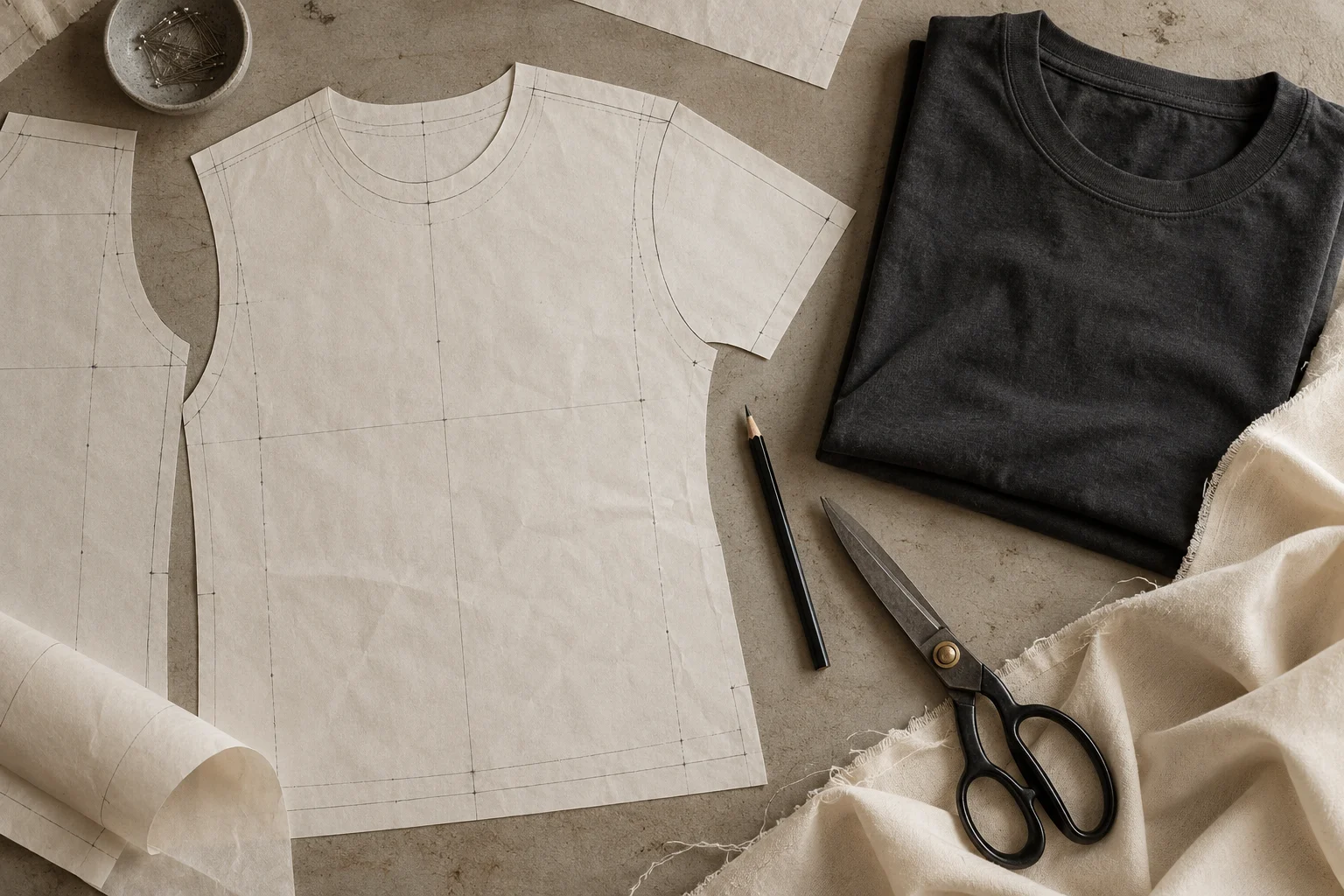
01 / Define the customer before the garment
Write down who will wear the product, in what setting and why they would choose it. A training top, a heavyweight streetwear tee and a hotel uniform solve different problems. Define the intended retail price and selling channel before choosing expensive finishes. A clear customer use case makes fabric, fit and construction decisions easier.
02 / Build a focused first range
A limited number of well-specified styles is easier to sample and control than a broad collection. Count quantities per style and per colour, not only across the brand. Three styles in four colours create twelve production variations. Shared fabrics can simplify sourcing, but they do not automatically remove a garment minimum.
03 / Prepare a file that can be quoted
Collect front and back visuals, fabric composition and weight, a measurement table, size range, colours, quantity breakdown, branding and delivery destination. Use our free tech pack builder to record these details. Mark unknowns honestly so they can be resolved rather than guessed by the cutting or sewing team. A complete, current file gives Tuğhan Textile a clearer basis for reviewing your product and the development work it may need.
04 / Validate the product and the budget
Review an indicative cost before development. Then evaluate the sample for fit, movement, fabric behaviour and decoration. Keep a revision log. Separate product cost from freight, duties, selling fees, returns and marketing. A product that is economical at factory level may still have an unrealistic retail margin.
05 / Approve, produce and learn
Approve the agreed sample and specification in writing before bulk production. Keep one controlled revision of the file and a sealed reference sample when practical. After launch, collect fit and wear feedback before repeating the order. Changes to dimensions, fabric or wash can require another validation cycle.
Why a price-only enquiry rarely produces a useful quote
“How much for 50 hoodies?” leaves almost every cost driver undecided. A factory cannot know whether you mean light terry or heavy brushed fleece, one colour or several, a basic hood or a lined construction, one print or multiple embroideries, or simple packing versus retail-ready presentation. Quoting without those decisions means guessing. Some suppliers will request a full specification, some will send an indicative range and some may decline or not reply. Silence is not proof that every factory dislikes startups; it can mean that the request is incomplete, below the factory’s minimum or outside its capabilities.
Small brand does not have to mean an unprepared buyer
You do not need a famous brand name to make a professional enquiry. You need enough information for the supplier to evaluate the product and the commercial opportunity. Explain your intended customer, the first order you can actually commit to, your material and construction requirements, and which decisions still need development. A realistic first order is more useful than an unsupported promise of very large future volumes. Seriousness is demonstrated by preparation, coherent decisions and follow-through, not by pretending to be bigger than you are.
A technical file is a way to avoid paying for assumptions
A complete tech pack gives the pattern maker, merchandiser and sewing team the same reference. Without it, several people may each interpret the product differently. That can create repeated questions, inconsistent offers, development fees and revisions. You may not have every answer at the first contact, but mark unknowns and ask whether the factory offers the development work needed to resolve them. A reference image can start a discussion; it does not define the fabric composition, finished measurements, internal construction, trim list or acceptance criteria.
Why 50–100 custom pieces can fall outside a factory’s business model
A small custom order still requires enquiry review, material sourcing, patterns, sample handling, cutting setup, sewing preparation, quality checks and commercial administration. Those activities do not disappear when the quantity is small. Fabric and accessory suppliers can also have separate minimums. A factory may therefore be unable to offer a viable price for 50–100 bespoke pieces, even if you offer to pay more per piece. Look for a provider whose operating model matches the project: stock blanks, an atelier, a sample room or a specialist small-run manufacturer may be more suitable. Our standard ready-fabric apparel policy remains 150 pieces per model and per colour.
Do not assume the factory will finance your brand launch
Manufacturers have their own cash commitments: fabric, trims, labour, processors and production capacity. Do not build your launch plan around receiving free development, unsecured credit or payment only after your collection sells. A factory’s actual financial position must be assessed individually; the presence of machinery or an impressive website is not evidence of solvency. Your first-order terms reflect the product, material commitments, relationship history and agreed risk allocation. Present a credible budget and discuss a payment structure before expecting work to begin.
NDA requests: reasonable protection, proportionate timing
Confidentiality can be a legitimate concern, including for a new brand. Asking for a relevant NDA does not automatically make you an undesirable customer, and you should not disclose genuinely confidential information simply to appear cooperative. The practical difficulty arises when a broad or heavily one-sided agreement is demanded before the factory can assess even a non-confidential product outline. First establish capability, minimums and mutual interest without exposing sensitive details; then agree suitable confidentiality arrangements before sharing protected information. If the agreement is important, obtain appropriate legal review.
What can make confidentiality discussions unnecessarily difficult
A general T-shirt silhouette, a protected invention, unreleased artwork and a proprietary process do not raise identical issues. Explain what information needs protection and the purpose for which it may be used. A factory may need approved access for pattern makers, staff or specialist processors. Very broad restrictions on unrelated future production, unexplained penalties, unclear governing law or obligations the supplier cannot operationally meet may trigger legal review or a refusal. These are negotiation issues, not a reason to assume every request is hostile. There is no universal rule that an NDA request automatically increases the price or deposit.
The commercial behaviour that matters after the first email
A well-prepared enquiry can still become difficult if quantities change repeatedly, approvals conflict, payments miss agreed dates or the buyer refuses to clarify unresolved details. Keep one decision owner, consolidate comments and identify the active file revision. Ask for the cost and timing effect of changes before authorising them. Professional cooperation reduces avoidable uncertainty. It does not remove the need for due diligence, written terms or the right to question an unclear proposal.
What to do if the factory sends a long questionnaire
Treat a relevant questionnaire as a specification checklist, not an insult. Answer known items directly and mark the rest as pending. Ask whether missing design work is a paid development service and whether the expected minimum fits your budget. If you cannot fund the minimum or define the product yet, pause the sourcing exercise and finish your preparation. Sending the same vague message to many more factories is unlikely to make the missing information less important.
Following up without creating more noise
Use one clear subject line and keep the project details in one thread. Refer to the style code, file revision and requested next step when you follow up. Respect the supplier’s stated review schedule and working days. Avoid attaching a different design in every message or seeking a firm price from an old incomplete file. If there is no fit, ask for a clear decline and move on rather than trying to turn an unsuitable supplier into a different kind of business.
Your first enquiry: make it possible to answer
Use a subject such as “Private-label cotton T-shirt enquiry — one model, two colours”. Include your brand, destination, product drawings, composition, construction, target GSM, size range, quantities per colour and size, branding, packaging and required delivery date. Mark undecided points as “please advise”. A short, complete enquiry is easier to assess than repeated messages asking only for the cheapest price. An incomplete enquiry may lead to a clarification request or no response; it does not prove the factory has rejected your business.
Turn a launch idea into an approval trail
Keep one revision number for the brief and one dated decision log. Record material selection, colour approval, fit comments, artwork approval, packaging and shipment release separately. When changing the fit, identify the measurement code and new target rather than writing “make it better”. Distinguish requests from decisions: “Can this be softer?” is a development question; “approve sample A after the agreed wash test” is a release instruction.
Start with fewer variables, then expand deliberately
Each extra model, fabric, colour, trim and print can create another minimum, setup charge and approval. A small collection is not automatically a small project. Consider one validated base fabric across compatible styles, fewer launch colours and a clearly prioritised hero product. Confirm compatibility first: a fabric that works for a relaxed T-shirt may not meet the opacity and recovery needs of leggings.
From a vague price question to a useful first enquiry
Hello, I want 50 hoodies. What is your best price? Please sign my NDA before we discuss anything.
The fabric, construction, colour split, branding, delivery point and development scope are all missing. A firm price would rely on assumptions.
We are developing one adult pullover hoodie in 350 gsm cotton-rich brushed fleece. First order: 150 pieces in one colour, sizes S–XL. Attached are our front/back views, draft POM table, trim list and one-colour chest print artwork. Delivery country: Germany. Please review material availability, feasibility, your sample policy, indicative price and the timeline after approval. We have marked the final rib specification as pending. Before sharing our separately identified confidential artwork, we would like to agree suitable confidentiality terms.
This still needs supplier review, but the assumptions and next step are visible. Replace every sample value with your own project details.
A first-enquiry template you can adapt
Subject: Manufacturing review — [style code] — [quantity per colour] — [delivery country]

Company / brand and contact:
Product type, intended wearer and fit:
Style code and technical file revision:
Fabric composition, construction, gsm and finish:
Colours and physical approval reference:
Quantities by model, colour and size:
Measurements / size range:
Print, embroidery, trims and labels:
Packing requirements:
Delivery country, named place and proposed delivery term:
Target timing and known constraints:
Target price or budget basis, if you wish to share it:
Attachments and artwork rights:
Pending decisions and required development service:
Confidential information to discuss separately, if applicable:

Please confirm capability, minimums, inclusions, sample/development policy, indicative pricing and the information still needed.
The factory’s enquiry triage: the questions behind the questions
| Factory needs to establish | What you should provide | What happens if it is missing |
|---|---|---|
| Product fit | Garment type, construction and visual references | Supplier cannot confirm capability |
| Material basis | Composition, construction, gsm, colour and finish | Fabric and consumption assumptions differ |
| Order commitment | Real quantities by model and colour | Minimums and setup cannot be assessed |
| Technical scope | POM, trims, decoration and pending decisions | Clarification or paid development may be needed |
| Commercial basis | Destination, intended delivery term and timeline | Quotes are not directly comparable |
| Approval process | Named decision owner and current file revision | Sampling and change control become uncertain |
A confidentiality discussion that protects the project
The operating perspective in this guide is that preparation and proportionate cooperation make a project easier to review. It is not a rule that factories dislike all NDAs or that a startup must waive confidentiality to obtain a fair price. Separate a non-confidential capability discussion from protected information, agree suitable terms before sensitive disclosure and keep the commercial and technical scope clear.
UK Intellectual Property Office: NDAs ↗ · UK guide: staged confidentiality discussions ↗
Original practical guidance. Confirm the current transaction, local requirements and contractual terms with the appropriate professional or authority.Is your project ready for a manufacturing review?
Launch budget: look beyond factory cost.
Avoid double-counting freight if your unit cost already includes it. Fill the destination budget with your own reviewed assumptions. The all-sold illustration excludes sales taxes, payment fees, discounts and returns; it is not a sales forecast.
A working glossary for your first collection.
GSM
Fabric mass in grams per square metre. It does not specify total garment weight.
Usable width
The fabric width available for cutting after excluding unusable edges or defects.
Greige
Fabric before the intended dyeing and finishing route; not automatically ready to cut.
Single jersey
A weft-knit construction with visually different face and reverse.
Interlock
A double-knit construction often used for a smooth, substantial fabric.
Pique
A textured knit construction commonly selected for polos.
French terry
A knit with looped reverse; different from a brushed reverse.
Brushed fleece
A fabric with a mechanically raised surface, commonly on the reverse.
Rib
A knit structure often used where stretch and recovery are needed.
Woven
Fabric formed by interlacing warp and weft yarns.
Warp
Yarns running along the length of a woven fabric.
Weft
Yarns running across the width of a woven fabric.
Elastane
An elastic fibre used in blends; percentage alone does not define stretch performance.
Recovery
How well material returns towards its original dimensions after deformation.
Drape
How a fabric hangs and forms folds.
Hand feel
The tactile impression of a fabric, influenced by construction and finishing.
Opacity
Resistance to showing what is behind a fabric; evaluate under relevant stretch and light.
Pilling
Entangled fibre balls that develop at a surface through wear and friction.
Spirality
Twisting or rotation visible in knitted fabric or a garment after relaxation or care.
Skew
Deviation of fabric courses or yarn alignment from the intended perpendicular orientation.
Shrinkage
A reduction in a measured dimension after a specified process.
Compacting
Mechanical finishing intended to influence fabric dimensions and stability.
Enzyme wash
A treatment whose effect depends on enzyme, substrate and processing conditions.
Lab dip
A small dyed reference submitted for colour approval.
Strike-off
A print trial submitted to review colour, artwork and substrate interaction.
Shade lot
A material group assessed together for colour consistency.
Tech pack
A controlled collection of product specifications, visuals and approval information.
BOM
Bill of materials: the component list for a product.
POM
Point of measure: a defined location and method for a dimension.
HPS
High point shoulder; state the exact measurement origin used for your garment.
Ease
The difference between body dimensions and garment dimensions for fit and movement.
Seam allowance
Material beyond the seam line reserved for assembly.
Grainline
The intended orientation of a pattern piece on the fabric.
Notch
A pattern or cut reference used to align assembly points.
Grading
Developing a size range from a base pattern using defined increments.
Marker
A planned arrangement of pattern pieces for cutting.
Marker efficiency
The proportion of marker area occupied by pattern pieces under the chosen layout.
Nap
A directional surface that may require consistent cutting orientation.
Proto sample
A development sample used to explore design and construction.
Fit sample
A sample assessed for dimensions, balance and movement.
Size set
Samples in selected or all sizes used to check grading and fit.
Pre-production sample
A sample intended to confirm agreed bulk-production details.
Sealed sample
An identified approved reference kept for production comparison.
Tolerance
An agreed permitted variation, linked to a measurement or acceptance criterion.
CMT
Cut, make and trim; confirm exactly what a supplier includes in this scope.
MOQ
Minimum order quantity, usually applying to a defined style and colour.
Lead time
The time measured from an agreed starting event to an agreed completion event.
Critical path
The dependent sequence of decisions and operations affecting completion.
Inline inspection
Quality review during production so issues can be addressed before the full run.
Final inspection
Review of finished goods against the agreed product and packing criteria.
Seam slippage
Movement of yarns near a seam that can create an opening or distortion.
Seam puckering
Unwanted gathering or rippling along a sewn seam.
Bartack
A concentrated reinforcement stitch at a defined stress point.
Topstitch
Visible stitching on the outside of a garment, decorative or functional.
Overlock
A seam or edge-finishing stitch that encloses the cut edge.
Coverstitch
A stitch construction commonly used for stretch garment hems.
Gusset
An inserted panel used for shape, movement or seam placement.
Placket
A finished opening construction, often with buttons or another closure.
Chargeable weight
The weight basis used by a carrier, which can differ from net product weight.
Landed cost
The total cost to bring goods to a defined destination under stated assumptions.
Markup
An addition expressed as a percentage of a cost base.
Margin
Profit expressed as a percentage of selling revenue; different from markup.
EXW / FOB / DAP / DDP
Delivery-term abbreviations. Agree the named place, current rules and exact responsibilities in the contract.
Private label
A product sold under the buyer’s brand; the development scope still needs definition.
Questions from first-time founders
Can I start without knowing anything about textiles?
Yes, but begin with one clearly defined product and use the guides to identify unknowns. You still need to approve the fabric, fit, branding, quantities and commercial terms.
Can I order 150 pieces split across five colours?
The standard ready-fabric minimum is 150 pieces per model and per colour. Five colours would normally mean 750 pieces for one model. Product and material exceptions are reviewed separately.
Can you make a garment from a photo?
A photo can communicate the look, but it cannot reliably define dimensions, internal construction, fabric composition or finishing. These details must be developed and agreed in a technical file.
Do I need a registered brand before asking for a quote?
You can prepare a manufacturing enquiry before launching a brand. You remain responsible for the right to use your brand name, artwork and any supplied designs.
Can you guarantee that my collection will sell?
No manufacturer can guarantee demand. Validate your audience, intended price and product positioning before committing to production.
What is the most common budgeting mistake?
Treating the sewing price as the complete landed cost. Include materials, decoration, trims, packaging, development, freight and destination charges, plus your own operating and selling costs.
Should I launch many styles or one strong product?
A focused range generally makes development, cash planning and feedback easier to manage. Decide based on your customer and distribution plan rather than trying to fill every category.
Can I mix sizes within one colour?
Yes, the size breakdown is normally agreed within the model and colour quantity. Extremely uneven splits or unusual sizes may affect feasibility and cost.
Why is a custom sample expensive compared with one bulk unit?
A sample includes one-off setup, pattern work, material sourcing and small-quantity handling that are spread over many units in bulk production. Our order-linked sample policy is explained on the sampling page.
Can I arrange a meeting before preparing my file?
Prepare your visuals, specifications and quantities first. Manufacturing meetings follow review of a complete file and acceptance of indicative pricing.
How much money do I need to launch?
There is no reliable universal launch budget. Build a style-by-style estimate, add development and logistics, then reserve funds for photography, your sales channel, marketing and returns.
Can I test demand before bulk production?
You can validate positioning, pricing and interest with your audience before placing an order. Any public mockups should accurately describe what customers will receive and the timing you can support.
What if I do not know the fabric name?
Describe the intended use, feel, stretch, opacity and finished weight. A physical reference and clear photos can help narrow the options before a fabric is approved.
Does a heavier fabric always mean better quality?
No. Fibre, yarn, knitting or weaving, finishing and construction all matter. Weight is only one specification; select it for the use and desired drape.
Can one fabric work for several styles?
Sometimes. Sharing a suitable fabric can simplify sourcing, but each style still needs its own fit, construction and production quantity review.
What should I send in my first email?
Send the product visuals, technical file or known specifications, quantities by colour and size, fabric target, branding, delivery country and target timeline. List anything still undecided.
When should I approve my size chart?
After checking the base-size sample and grading plan. Body measurements and finished garment measurements are different; state which your table contains.
Can I change my design after approving the sample?
A change can affect patterns, materials, cost and delivery. Send it in writing and wait for a revised feasibility review before assuming it is included.
Who owns my supplied artwork?
You should hold the necessary rights to the artwork and designs you submit. Agree any ownership and permitted-use terms for newly developed files in the order documents.
How do I compare two factory quotes fairly?
Use the same technical file, material specification, order breakdown and delivery terms. Check inclusions, exclusions, taxes, sample policy and quality approval requirements.
Can my collection share one fabric but use different colours?
Possibly, but each colour may create a dyeing minimum and each style/colour still needs a production review. Confirm material and garment minimums separately.
What is the difference between a retail margin and a factory markup?
Markup is calculated on cost; margin is calculated on sales revenue. A 15% cost markup does not create a 15% sales margin. Use the planning worksheet to compare them.
Should I order all sizes equally?
Use evidence about your target customer and intended channel. Equal splits are easy to list but are not proof of demand; confirm any extreme split with the manufacturer.
Can a digital mockup replace a sample?
A mockup helps communicate the look. It does not validate actual fabric hand, seam behaviour, fit or care performance.
What should I keep from my first production?
Keep the approved file revision, sample references, material records, change log, final packing list and relevant inspection results.
How do I avoid paying for changes twice?
Consolidate feedback, identify a file revision and ask for the cost and timing effect before authorising the change.
Do I need separate artwork for each print size?
Provide artwork at the intended dimensions and identify size-dependent changes. Do not assume the production team will infer scaling across the range.
Should I use the same supplier for every product?
Review capability by product and material. A supplier suited to jersey essentials may not be suited to every specialist garment.
Can I use a competitor’s branded garment as my design?
A reference can explain a fit or construction objective, but you need the necessary rights for any supplied design or artwork. Develop your own specification and branding.
How do I know which decisions are still missing?
Use the readiness checklist on this page. Record unknowns as pending, then assign an owner and approval date before production.
Why do factories ignore price-only emails?
A request without product, material and quantity details may be impossible to cost or may fall outside the supplier’s minimum and capability. Some suppliers ask for clarification, some decline and some do not reply; there is no universal factory response.
Do I need to be a big brand to be taken seriously?
No. A complete brief, realistic quantities, a credible budget and reliable approvals make an enquiry easier to evaluate. An unsupported promise of future volume is less useful than a workable first order.
Can I ask for a price with only a photo?
You can ask for an indicative discussion, but the supplier will need material, dimensions, construction, decoration, quantities and delivery details to prepare a comparable offer.
Will every manufacturer accept 50 or 100 custom garments?
No. Some businesses specialise in small runs, while others cannot spread their development and setup over that quantity. Find a provider whose business model fits the order.
Should I hide that I am a startup?
No. Be accurate about your stage and what you can commit to. Preparation and honest assumptions are more useful than pretending to have a larger business.
Do factories offer free development to win startup customers?
Some providers offer defined development services; others start sampling only after an order. Confirm scope and charges rather than assuming that enquiry review includes free product development.
Does an NDA request automatically make me a risky customer?
No. A proportionate confidentiality request can be appropriate. Difficulty arises when the scope, timing or obligations are unsuitable for the discussion.
Should I share confidential designs before an NDA is agreed?
Do not share genuinely confidential information just to accelerate a quote. A non-confidential overview can establish initial capability while suitable protection is discussed.
Can a factory refuse my NDA?
It may decline or propose changes if the obligations are unsuitable. That decision alone does not prove bad intent; you can seek a workable agreement or choose a different partner.
Will asking for an NDA automatically increase the price?
There is no universal rule. Legal review and unresolved commercial obligations can affect a negotiation, but an NDA request alone does not determine price or payment terms.
What should I do with a detailed supplier questionnaire?
Answer known points, identify pending decisions and ask whether missing development work is a service the supplier can provide. Consolidate the answers in one controlled file.
Should I contact many suppliers with the same incomplete brief?
Complete the brief first. Otherwise, replies and prices may reflect different assumptions rather than a genuine comparison.
Can I require a meeting before sharing basic specifications?
A supplier may first need a non-confidential outline, quantities and an indicative price fit. Meetings do not replace the information needed to evaluate feasibility.
What makes a follow-up professional?
Keep one project thread, identify the style and file revision, state what is missing and request a clear next step within the supplier’s stated review process.
Can a factory’s financial strength be inferred from its website?
No. Marketing, buildings and machinery do not establish solvency or a willingness to finance your development. Assess the actual counterparty and agreed terms.
Is the brand workspace an AI consultant?
It is a guided browser tool using explicit completeness and MOQ checks. It does not inspect your attachments, verify a supplier or replace a technical review.
Does recording every field mean my product is approved?
No. It means the listed information is recorded. The manufacturer must review feasibility, physical references, measurements, scope, price and approvals.
Can I prepare a brief if I do not know the fabric yet?
Yes. Choose material development and record what you need. The workspace highlights that material decisions are unresolved rather than inventing a fabric specification.
Does the workspace PDF replace a tech pack?
The brief is an enquiry summary. Use the direct handover to the technical builder, then add drawings, measurements and construction detail.
Can I reopen my saved brief on another device?
Customer downloads are PDF only, with TUGHAN TEXTILE on every page. Editing continues from the local draft in the same browser; the PDF is not an editable project backup or an authenticated approval.
Are the attachment checkboxes proof my files are adequate?
No. They are your declarations only. Attach the actual files to your email and ask the supplier to review them.
Can I use the workspace for a whole collection?
Use a separate brief for each model and list its colours and sizes in the order matrix. Record size allocation within each brief and review collection-wide material minimums separately.
Can I pass my brief into the contact form?
Yes. On the contact page choose Use my saved brief to fill matching empty fields and append its summary once. Review the form and attach your files before sending.
Can I ask for a price before I have a tech pack?
Yes, but identify it as an early budget discussion. Supply a product description, reference visuals, material target, quantity by model and colour, decoration and destination. A reliable production quotation requires the missing technical decisions to be resolved.
Will a factory ignore a startup asking for 50–100 pieces?
Some factories cannot support that run economically; others may offer a suitable stock-based programme. A complete brief helps them assess it. Avoid assuming that startup status itself is the problem. Check the stated minimums and ask about a workable scope.
Do I need every colour and every size on my first launch?
Build the quantity matrix first. More colours can create more separate minimums, while too many sizes can fragment stock. Choose the range deliberately using your customer research and confirm production feasibility.