In this guide · 8 practical sections
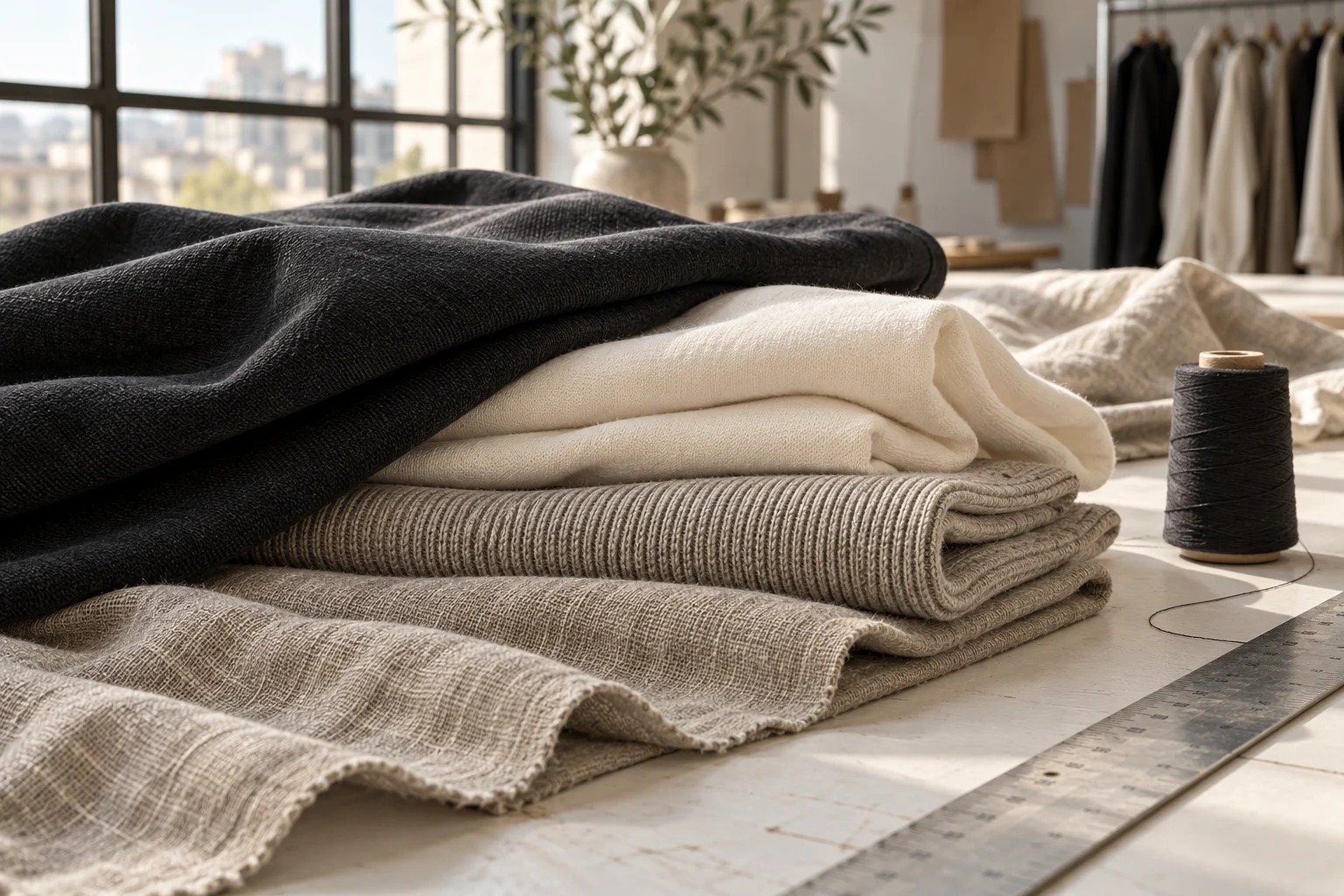
Understand the intended result
Enzyme treatments can alter surface appearance and feel on suitable cellulosic fabrics, while silicone treatments can influence softness. Brushing, compacting and other mechanical processes change the surface or stability in different ways. A process name alone does not guarantee a result on every fibre blend.
Test the actual combination
The fabric, dye, decoration, seams and care process interact. Test the actual material and intended finish before bulk treatment. Assess shade change, dimensional change, spirality, surface fuzz, seam appearance and stretch recovery as relevant. A strong treatment that improves softness may reduce another property.
Shrinkage allowance needs measurement
Measure a marked sample before and after the agreed care cycle. Record both length and width changes; they may differ. If a dimension shrinks by 2%, an exact pre-process target for 70 cm is 70 ÷ 0.98, approximately 71.43 cm. The appropriate pattern allowance still needs factory validation.
Agree what is approved
Keep a reference for shade and hand feel. Define whether a wash happens before cutting, after sewing or only in the consumer care test. Vintage and garment-washed appearances may have intentional variation; agree an acceptable range instead of expecting every piece to be visually identical.
Softness must survive the agreed care method
Approve hand feel before and after washing, with the same care procedure for all candidates. A finishing treatment can change surface feel, appearance and dimensions, so record the exact approved material and finish instead of asking for “maximum softness”. Recheck decoration adhesion and measurements when finishing changes. Ask for a trial before assuming a treatment will solve a construction or fibre-selection problem.
A wash test needs a repeatable record
Record sample ID, conditioning, wash temperature and programme, detergent, drying method, number of cycles and measurement points. Photograph the same views before and after. Keep shade change, pilling, twisting, seam appearance and dimensional change as separate observations. Agree the test method and acceptance limit in writing; an example target in an online guide is not an automatic contractual standard.
Process route: define when the finish happens.
| Route | What it can change | Decision before bulk |
|---|---|---|
| Fabric finish before cutting | Fabric handle, dimensions and surface before patterns are cut | Validate finished fabric and usable width |
| Garment wash after sewing | Whole-garment appearance, dimensions, seams and trims | Approve garment construction and wash result together |
| Post-decoration processing | Print/embroidery and material interact with later treatment | Test the intended sequence on actual materials |
| Consumer care test | Simulates the agreed care instructions under defined conditions | Record cycle, drying, measurement and acceptance criteria |
Further technical reading: CottonWorks quality testing ↗ · Dimensional change and skew ↗. Tables are original planning guidance, not specifications or test certificates.
Shrinkage and target-size worksheet
Pre-process target = finished target ÷ (1 − shrinkage/100). Apply separately by direction. Pattern allowances must be validated on the actual fabric and process.
Questions, answered
Will washing prevent all pilling?
No treatment can guarantee that for every product. Pilling depends on fibre, yarn, construction, friction and care; evaluate the actual material.
Should I use a fixed shrinkage percentage for every fabric?
No. Measure the relevant fabric and process. Different directions and colour lots can behave differently.
Does a softer fabric always mean a better finish?
No. A finish can improve one property while changing another. Evaluate softness together with colour, dimensions, strength and care appearance.
Should printing be tested before or after washing?
Test the actual intended production and care sequence. The order of treatment and decoration can influence the result.
Can softening fix every stiff fabric?
No. First identify whether the issue comes from fibre, yarn, construction, weight or finish. Request a trial and review care performance, dimensions and decoration compatibility before changing the production finish.
How many washes prove a fabric is good?
There is no single universal number for every garment. Agree the method, cycles, care conditions, properties and acceptance limits appropriate to the product.